


Outsourced Accounting Services for U.S. Businesses: Why Remote Finance Teams Are Replacing In-House Accounting
The Hidden Cost of Managing Accounting Internally
Many startups, growing businesses, and CPA firms across the United States are discovering the same problem: maintaining an in-house accounting department is becoming expensive, inefficient, and difficult to scale.
As businesses grow, founders and operations teams often spend valuable hours on bookkeeping tasks, payroll entries, reconciliations, vendor payments, and financial reporting instead of focusing on growth.
What initially starts as a “temporary internal solution” slowly turns into the following:
- Delayed financial reporting
- Inaccurate books
- Payroll mistakes
- Cash flow confusion
- Tax compliance risks
- Increased staffing costs
For many businesses, outsourced accounting is no longer just a cost-saving option — it has become a smarter operational strategy.
What Is Outsourced Accounting?
Outsourced accounting refers to hiring an external, remote finance team to manage accounting and bookkeeping operations rather than building a full in-house department.
Businesses can outsource:
- Daily bookkeeping
- Accounts payable and receivable
- Payroll accounting
- Bank reconciliations
- Month-end closing
- Financial reporting
- MIS reporting
- CFO support
- Tax-ready financial preparation
This model allows businesses to access professional accounting expertise without hiring full-time employees.
Why U.S. Businesses Are Moving Toward Remote Accounting Teams
Remote accounting has become increasingly popular among startups, SMBs, and CPA firms because it provides flexibility, scalability, and cost control.
Instead of spending heavily on recruitment, salaries, employee benefits, software licenses, and training, businesses can work with dedicated accounting professionals remotely.
This approach helps companies:
- Reduce overhead expenses
- Improve financial accuracy
- Access experienced accounting talent
- Scale operations faster
- Improve reporting consistency
- Reduce dependency on a single employee
Common Problems With In-House Accounting Teams
High Salary and Employee Costs
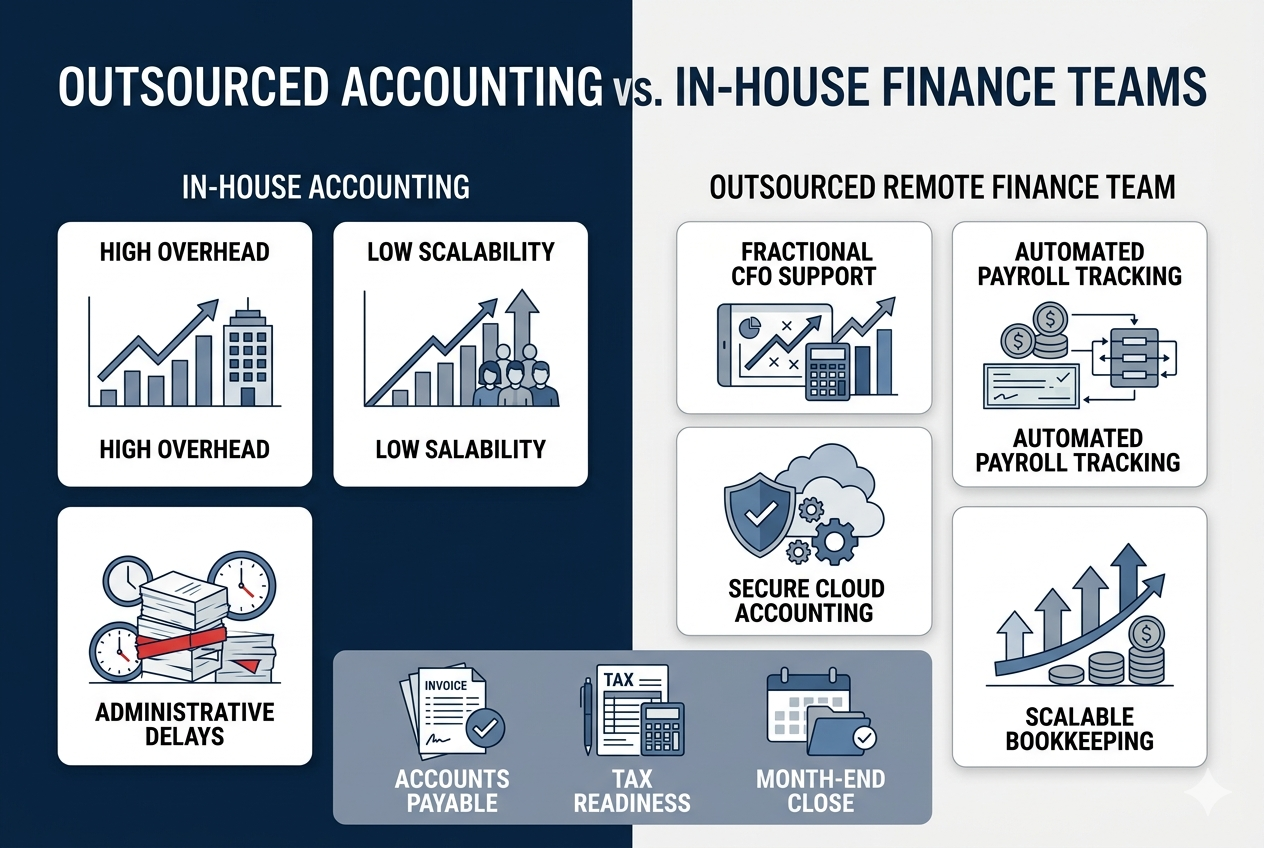
Hiring an experienced accountant in the U.S. can be expensive once salary, payroll taxes, insurance, software, and employee benefits are added together.
For startups and small businesses, these costs often outweigh the actual accounting workload.
Difficulty in Scaling
As transaction volume increases, businesses need additional accounting support. Hiring new employees takes time and creates operational disruption.
Outsourced accounting allows businesses to scale support immediately without rebuilding internal systems.
Reporting Delays
Many growing companies struggle to close books on time. Delayed reconciliations and incomplete reporting create poor visibility into financial performance.
Without accurate monthly reports, decision-making becomes difficult.
Employee Dependency Risk
Internal accounting processes often become dependent on one employee. If that person resigns, businesses face major operational challenges.
Remote accounting firms provide continuity and structured workflows.
Outsourced Accounting Services Offered to U.S. Businesses
Modern remote accounting providers support businesses across multiple industries with end-to-end finance operations.
Bookkeeping Services
Daily transaction recording, expense categorization, ledger maintenance, and bookkeeping cleanup.
Bank & Credit Card Reconciliation
Regular reconciliation helps identify discrepancies early and keeps books accurate.
Payroll Accounting Support
Payroll entries, tax deductions, payroll reconciliation, and payroll accounting integration.
Accounts Payable & Receivable
Managing vendor payments, invoices, receivables tracking, and customer collections.
Financial Reporting & MIS
Businesses receive:
- Profit & Loss statements
- Balance Sheets
- Cash Flow reports
- Management dashboards
- Budget tracking reports
Month-End & Year-End Close
Structured closing procedures ensure books remain audit-ready and tax-ready throughout the year.
Cloud Accounting Software Management
Remote accounting teams commonly work with:
- QuickBooks
- Xero
- Zoho Books
- FreshBooks
- NetSuite
without requiring businesses to change existing systems.
Why Startups Benefit Most From Outsourced Accounting
Early-stage startups typically prioritize product development, hiring, fundraising, and customer acquisition.
Accounting often gets delayed until:
- Investors request due diligence
- Tax filings become urgent
- Cash flow problems appear
- Financial statements are required
Outsourced accounting helps startups build financial discipline from the beginning without creating expensive internal finance departments.
This is especially useful for:
- SaaS startups
- E-commerce brands
- D2C businesses
- Venture-backed startups
- Multi-state businesses
Why CPA Firms Outsource Bookkeeping Operations
Many CPA firms are outsourcing bookkeeping and reconciliation work to improve efficiency and increase advisory capacity.
Instead of allocating senior staff to repetitive accounting tasks, firms can focus on:
- Tax strategy
- Advisory services
- Audit support
- Client relationships
- Business consulting
This improves profitability while reducing internal workload pressure.
Remote Accounting vs In-House Accounting
Factor | In-House Accounting | Outsourced Accounting |
Salary Costs | High | Lower |
Employee Benefits | Required | Not Applicable |
Hiring & Training | Time-consuming | Minimal |
Scalability | Slow | Flexible |
Software Costs | Additional | Often Included |
Turnover Risk | High | Reduced |
Reporting Support | Depends on the staff | Structured |
How Outsourced Accounting Improves Financial Visibility
One major advantage of outsourced accounting is consistent access to real-time financial information.
Businesses can better monitor the following:
- Cash flow
- Profitability
- Operating expenses
- Revenue growth
- Budget performance
- Vendor liabilities
Timely reporting improves decision-making and investor confidence.
Is Remote Accounting Safe?
Professional outsourced accounting firms use:
- Secure cloud platforms
- Encrypted data systems
- Restricted access controls
- Confidentiality agreements
- Role-based permissions
In many cases, remote accounting systems provide stronger security than traditional spreadsheet-based internal processes.
How to Choose the Right Outsourced Accounting Partner
Before selecting an accounting partner, businesses should evaluate:
Industry Experience
The provider should understand your industry-specific workflows and reporting needs.
Software Expertise
Ensure the accounting team works with your current accounting platform.
Software Expertise
Ensure the accounting team works with your current accounting platform.
Scalability
The provider should support business growth without disrupting accounting continuity.
Data Security
Review their confidentiality policies and security infrastructure carefully.
The Future of Accounting Is Remote
The shift toward outsourced accounting is accelerating across the United States because businesses now prioritize efficiency, flexibility, and cost optimization.
Companies no longer need large in-house accounting departments to maintain strong financial operations.
With the right outsourced accounting partner, businesses can:
- Reduce operating costs
- Improve reporting accuracy
- Strengthen compliance
- Gain financial clarity
- Scale faster
Conclusion
Outsourced accounting is helping U.S. startups, SMBs, and CPA firms simplify finance operations while reducing internal costs and administrative pressure.
Instead of spending time managing internal accounting processes, businesses can focus on growth, customers, and strategic decision-making.
Remote bookkeeping and accounting support provide a scalable, reliable, and cost-effective alternative to traditional in-house accounting models—making it one of the smartest operational decisions modern businesses can make.
Any Questions? Look Here
Outsourced accounting is a service where businesses hire an external accounting team to manage bookkeeping, payroll, reconciliations, financial reporting, and other accounting functions remotely instead of maintaining a full in-house accounting department.
Many U.S. businesses outsource accounting to reduce operational costs, improve reporting accuracy, save time, and access experienced finance professionals without hiring full-time staff.
Yes. Outsourced bookkeeping is usually more cost-effective because businesses avoid expenses related to salaries, employee benefits, payroll taxes, recruitment, training, and accounting infrastructure.
Businesses can outsource:Bookkeeping Payroll accounting Accounts payable & receivable Financial reporting Bank reconciliations Month-end closing Tax-ready bookkeeping CFO support services
Professional accounting firms use encrypted systems, cloud accounting software, secure portals, and confidentiality agreements to protect financial data and maintain security standards.
Industries that commonly benefit include:Startups SaaS companies CPA firms E-commerce businesses Healthcare practices Agencies and consultants Retail businesses Multi-state companies
Yes. Many CPA firms outsource bookkeeping and reconciliation work to improve turnaround time, reduce operational pressure, and focus more on tax advisory and client consulting services.
Most outsourced accounting teams work with:QuickBooks Xero Zoho Books FreshBooks NetSuite Wave Accounting
Outsourced accounting provides regular financial reports such as:Profit & Loss statements Cash Flow reports Balance Sheets Expense tracking Accounts receivable aging reportsThis helps businesses make better financial decisions.