


AI vs Human Accountants: Why the Future of Business Finance Depends on Both
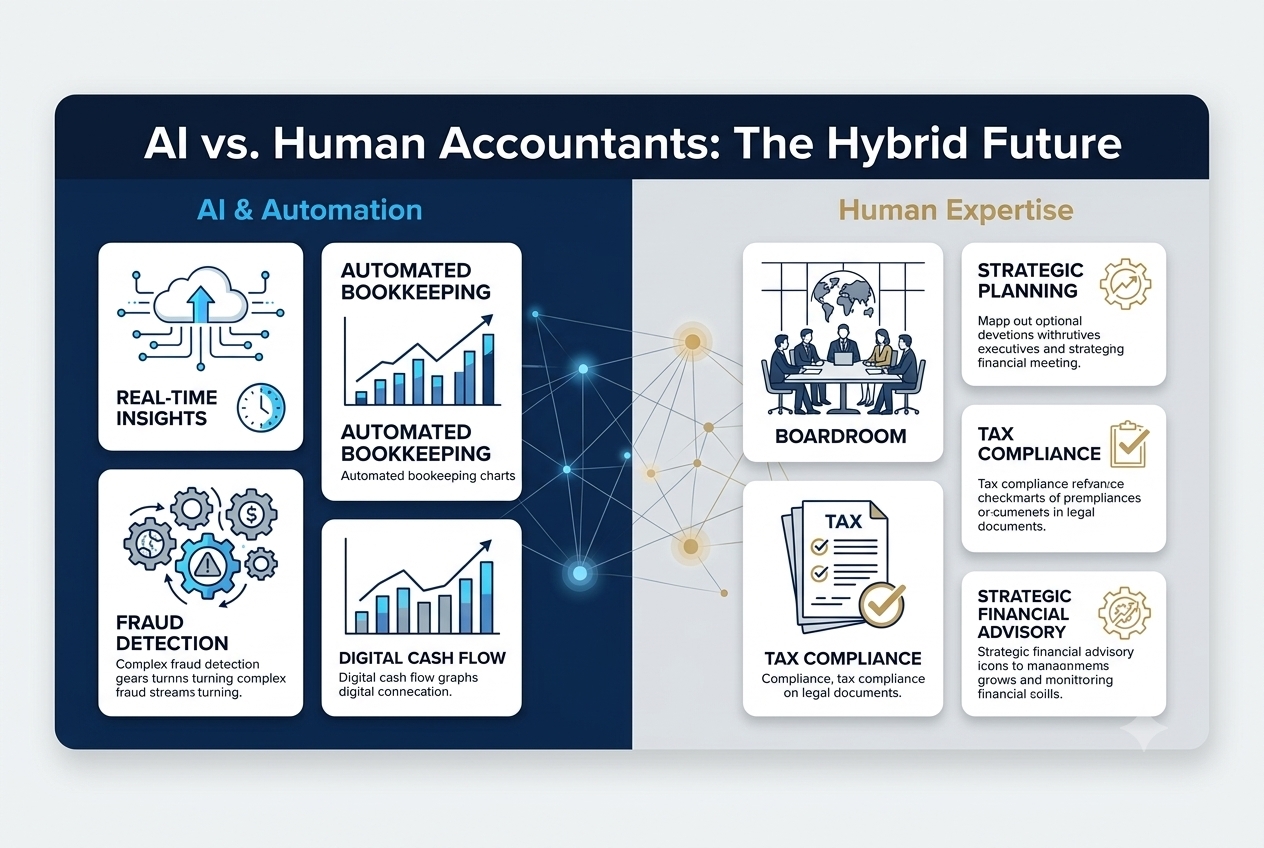
Businesses today are under constant pressure to make faster decisions, maintain compliance, reduce costs, and improve financial visibility. As artificial intelligence continues transforming the accounting industry, many business owners are asking the same question:
Will AI replace accountants?
The reality is far different.
The most successful businesses are not choosing between artificial intelligence and human accountants. Instead, they are combining the strengths of both to create a smarter, more efficient financial management system.
AI delivers speed, automation, and data accuracy, while human accountants provide judgment, strategic advice, and business insight. Together, they help organizations improve financial performance and make more informed decisions.
Why AI-Powered Accounting Is Becoming Essential
Across the globe, businesses are rapidly adopting AI-driven accounting technologies to streamline operations and stay competitive.
Several factors are driving this shift:
- Growing demand for real-time financial reporting
- Increased regulatory and compliance requirements
- Rising operational costs
- Need for faster business decisions
- Expansion of cloud-based accounting systems
Companies that embrace technology are finding it easier to manage financial processes while maintaining accuracy and compliance.
Where AI Excels in Modern Accounting
Artificial intelligence has transformed routine accounting activities that traditionally consumed significant time and resources.
Automated Bookkeeping and Transaction Processing
AI-powered systems can automatically record, categorize, and organize financial transactions without manual intervention.
This helps businesses:
- Reduce bookkeeping errors
- Improve transaction accuracy
- Save administrative time
- Maintain updated financial records
Tasks that once required hours of manual effort can now be completed within minutes.
Faster Account Reconciliation
Reconciling bank accounts, credit cards, and financial statements is one of the most time-consuming accounting functions.
AI can:
- Match transactions instantly
- Identify discrepancies
- Flag missing entries
- Generate reconciliation reports automatically
This allows finance teams to focus on higher-value activities.
Advanced Fraud Detection
Artificial intelligence can analyze large volumes of financial data and identify unusual transactions or suspicious patterns.
By continuously monitoring financial activity, businesses can:
- Detect potential fraud early
- Reduce financial risks
- Improve internal controls
- Strengthen governance practices
Real-Time Financial Insights
AI provides instant visibility into business performance.
Modern accounting platforms can generate:
- Cash flow reports
- Profitability analysis
- Expense tracking dashboards
- Revenue forecasts
Business leaders can access critical information whenever they need it.
Continuous Availability
Unlike manual processes, AI-driven systems operate around the clock.
This enables:
- Faster reporting
- Immediate transaction processing
- Continuous monitoring
- Improved operational efficiency
Why Human Accountants Remain Irreplaceable
While artificial intelligence can process data efficiently, it cannot replicate human experience, business understanding, or professional judgment.
Strategic Financial Planning
Human accountants do far more than maintain books.
They help businesses:
- Develop growth strategies
- Improve profitability
- Plan investments
- Optimize tax structures
- Manage financial risks
Strategic thinking remains a uniquely human capability.
Business Context and Interpretation
AI can identify trends and generate reports, but it cannot fully understand business realities.
Accountants interpret financial information based on:
- Industry conditions
- Market dynamics
- Economic changes
- Business objectives
- Competitive challenges
This context is essential for sound decision-making.
Compliance and Regulatory Guidance
Tax laws and financial regulations often must interpretation rather than simple rule application.
Human professionals provide valuable support in areas such as:
- Tax planning
- Regulatory compliance
- Audit preparation
- Corporate governance
- Risk management
Professional judgment plays a critical role in ensuring compliance.
Relationship Management and Advisory Services
Business owners often need more than financial reports.
They need trusted advisors who can:
- Explain financial performance
- Discuss business challenges
- Recommend practical solutions
- Support strategic decisions
Strong professional relationships create value that technology alone cannot provide.
Problem Solving and Innovation
Every business faces unique financial challenges.
Human accountants can test many solutions, adapt strategies, and develop creative approaches that AI systems are unable to generate independently.
AI and Human Accountants: A Powerful Partnership
The future of accounting is built on collaboration rather than competition.
What AI Contributes
- Transaction automation
- Data processing
- Real-time reporting
- Error reduction
- Pattern recognition
What Human Accountants Contribute
- Financial strategy
- Business insight
- Regulatory expertise
- Decision-making support
- Client relationships
Together, they create a stronger financial ecosystem that delivers both operational efficiency and strategic value.
How the Hybrid Accounting Model Works
Modern businesses are increasingly adopting a hybrid approach that combines technology with professional expertise.
Step 1: Automate Routine Financial Tasks
AI manages repetitive activities such as:
- Bookkeeping
- Data entry
- Invoice processing
- Account reconciliation
This reduces manual workload and improves accuracy.
Step 2: Generate Real-Time Financial Visibility
AI-powered dashboards provide instant access to:
- Revenue trends
- Cash flow performance
- Budget analysis
- Expense monitoring
Business leaders gain faster access to actionable information.
Step 3: Human Review and Validation
Experienced accountants review financial outputs to ensure:
- Accuracy
- Compliance
- Consistency
- Business relevance
This more layer of oversight strengthens reliability.
Step 4: Strategic Analysis and Planning
Finance professionals use AI-generated insights to support:
- Budget planning
- Growth strategies
- Investment decisions
- Cost optimization
- Financial forecasting
The combination produces more informed business decisions.
Step 5: Scale Operations Efficiently
As businesses grow, AI helps handle increasing transaction volumes while accountants continue providing strategic guidance.
This allows organizations to expand without significantly increasing finance department costs.
Benefits of Combining AI with Human Accounting Expertise
Businesses adopting a hybrid accounting model often experience:
Improved Accuracy
Automation minimizes data entry errors while human oversight ensures quality control.
Lower Operating Costs
Businesses can reduce administrative expenses without sacrificing financial expertise.
Faster Reporting
Real-time processing enables quicker access to financial information.
Better Compliance
Technology supports reporting requirements while accountants ensure regulatory alignment.
Stronger Business Decisions
Combining data intelligence with human judgment leads to more effective planning and execution.
The Future of Accounting Is Hybrid
Artificial intelligence is transforming accounting, but it is not replacing accountants.
Instead, it is enabling finance professionals to focus on higher-value activities while technology handles routine tasks.
Businesses that leverage both AI-powered automation and human expertise gain the best of both worlds:
- Faster operations
- Greater accuracy
- Better compliance
- Stronger financial control
- Smarter strategic decisions
As accounting continues to evolve, the organizations that combine technology with professional insight will be best positioned for long-term growth and success.
The question is no longer whether businesses should choose AI or human accountants. The real opportunity lies in using both together to create a more intelligent and efficient finance function.
Any Questions? Look Here
No. AI is designed to automate repetitive accounting tasks such as bookkeeping, reconciliations, and data processing. Human accountants remain essential for strategic planning, compliance interpretation, tax advisory, and business decision-making.
A hybrid accounting model offers faster processing, improved accuracy, real-time financial insights, stronger compliance management, and expert financial guidance for business growth.
AI can automate transaction categorization, bank reconciliations, invoice processing, payroll calculations, financial reporting, and anomaly detection, significantly reducing manual effort.
Tasks involving judgment and strategy require human involvement, including tax planning, financial forecasting, audit support, regulatory interpretation, budgeting, and business advisory services.
Yes. AI-powered accounting tools help small businesses reduce costs, improve efficiency, and gain real-time visibility into their finances while still benefiting from professional accountant oversight.
AI reduces manual data entry errors and automates calculations, resulting in more accurate financial reports and faster month-end closing processes.
AI provides data, but accountants provide context. Human professionals analyze financial information, identify opportunities, manage risks, and guide business decisions based on real-world circumstances.
Startups, SMEs, e-commerce businesses, healthcare providers, professional services firms, manufacturing companies, and multinational organizations can all benefit from AI-enhanced accounting processes.
Most modern AI accounting platforms use advanced encryption, secure cloud infrastructure, and role-based access controls to protect sensitive financial information.
The future is a hybrid model where AI handles routine financial operations while accountants focus on strategy, compliance, advisory, and business growth initiatives.