


10 Accounting Processes Every Business Should Automate in 2026
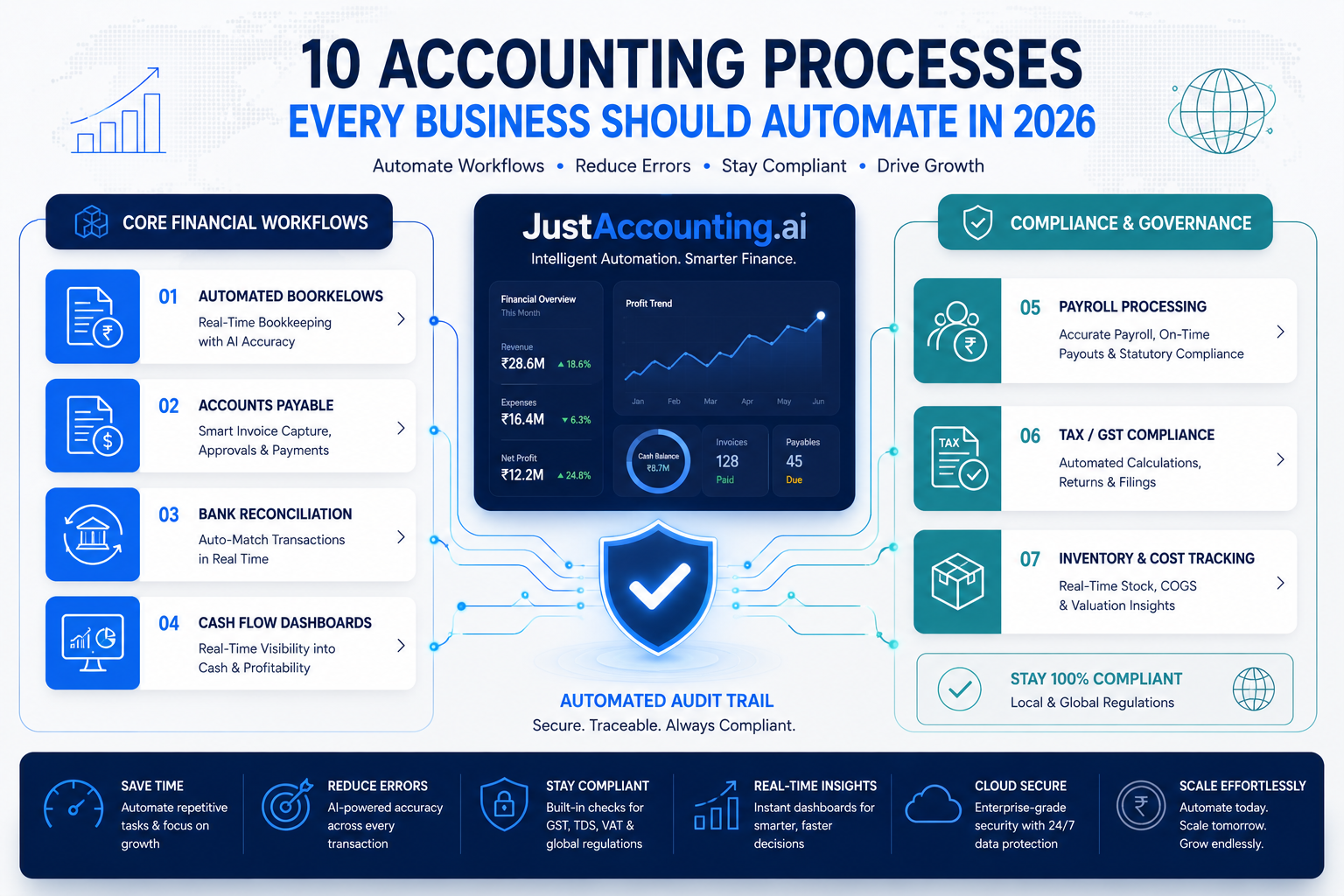
Why Accounting Automation Has Become Essential for Modern Businesses
In 2026, businesses are under increasing pressure to maintain accurate financial records, meet compliance requirements, and make faster data-driven decisions. Whether you operate a startup in Bengaluru, an SME in Dubai, or a growing company in London, manual accounting processes can slow growth and increase operational risk.
Organizations that embrace accounting automation are achieving:
- Significant reductions in manual accounting tasks
- Improved bookkeeping accuracy
- Faster month-end and year-end closures
- Better GST, VAT, TDS, and payroll compliance
- Real-time visibility into business performance and cash flow
Modern AI-powered accounting platforms, such as JustAccounting.ai, help businesses streamline financial operations and improve efficiency and scalability.
1. Automate Bookkeeping and Transaction Classification
Bookkeeping is the foundation of every accounting system. Manual data entry often leads to inconsistencies, delays, and reporting errors.
Benefits of Automation
- Automatic transaction categorization
- Consistent chart of accounts mapping
- Reduced manual intervention
- Real-time financial records
Business Impact
Automated bookkeeping keeps financial data up to date daily, allowing business owners and finance teams to make informed decisions without waiting for month-end reports.
2. Automate Accounts Payable (AP) Management
Managing supplier invoices manually consumes valuable time and increases the risk of duplicate payments and approval delays.
Automated AP Functions
- Invoice data extraction using AI and OCR
- Vendor invoice validation
- Approval workflow automation
- Scheduled payments
- Real-time vendor ledger updates
Business Impact
Companies can improve vendor relationships, reduce processing costs, and gain greater control over outgoing payments.
3. Automate Accounts Receivable (AR) and Collections
Maintaining healthy cash flow requires timely invoicing and efficient collection processes.
What Automation Can Handle
- Automatic invoice generation
- Payment reminders
- Customer follow-ups
- Receipt matching
- Ledger reconciliation
Business Impact
Automated receivables management helps businesses collect payments faster and improve working capital management.
4. Automate Bank Reconciliation
Reconciling bank transactions manually is one of the most time-consuming accounting activities.
Automation Features
- Instant transaction matching
- Automated exception reporting
- Continuous account updates
- Real-time reconciliation status
Business Impact
Finance teams can complete reconciliations faster while improving accuracy and reducing manual effort.
5. Automate Payroll Processing and Compliance
Payroll mistakes can lead to employee dissatisfaction, compliance issues, and regulatory penalties.
Payroll Automation Includes
- Salary calculations
- Tax deductions
- Payslip generation
- Leave and attendance integration
- Compliance reporting
Business Impact
Employees receive accurate and timely payments while businesses maintain payroll compliance.
6. Automate GST, VAT, TDS, and Tax Compliance
Tax regulations continue to evolve across multiple jurisdictions, making compliance management increasingly complex.
Automated Compliance Functions
- Tax calculations
- Return preparation
- Compliance tracking
- Error identification
- Filing reminders
Business Impact
Businesses reduce compliance risks and avoid costly penalties while ensuring timely tax submissions.
7. Automate Expense Management
Expense reporting often creates administrative bottlenecks for both employees and finance teams.
Automation Capabilities
- Digital receipt capture
- Automatic expense categorization
- Policy validation
- Approval workflows
- Reimbursement tracking
Business Impact
Organizations gain better control over spending while reducing administrative workload.
8. Automate Financial Reporting and Business Dashboards
Traditional reporting methods often delay access to critical financial insights.
Automated Reporting Includes
- Profit and Loss Statements
- Balance Sheets
- Cash Flow Reports
- Department-wise analysis
- Financial forecasts
Business Impact
Decision-makers receive real-time financial visibility and can respond quickly to changing business conditions.
9. Automate Inventory and Cost Accounting
Inventory management directly affects profitability and cash flow for product-based businesses.
Key Automation Features
- Inventory tracking
- Cost of Goods Sold (COGS) calculations
- Purchase order integration
- Real-time stock valuation
- Inventory alerts
Business Impact
Businesses can optimize inventory levels, reduce carrying costs, and improve forecasting accuracy.
10. Automate Audit Readiness and Documentation
Preparing for audits becomes significantly easier when records are organized continuously throughout the year.
Automation Supports
- Centralized document management
- Digital audit trails
- Compliance monitoring
- Ledger organization
- Exception reporting
Business Impact
Audit preparation becomes faster, more transparent, and less disruptive to daily operations.
Why Accounting Automation Is a Business Necessity in 2026
Governments worldwide are moving toward digital compliance frameworks, e-invoicing systems, and real-time reporting requirements.
Businesses that continue relying on manual accounting processes often face challenges with:
- Operational efficiency
- Financial accuracy
- Regulatory compliance
- Scalability
- Profitability
Automation is not designed to replace accountants. Instead, it enables finance professionals to focus on strategic analysis, forecasting, and business growth.
How JustAccounting.ai Helps Businesses Automate Financial Operations
JustAccounting.ai provides a comprehensive accounting automation platform designed for startups, SMEs, and enterprises.
Key Capabilities
- Automated bookkeeping
- GST, VAT, and TDS compliance management
- Accounts payable and receivable automation
- Real-time financial dashboards
- Faster month-end closing
- AI-powered financial workflows
Why Businesses Choose JustAccounting.ai
- Supports Indian and international compliance requirements
- Integrates with banks, ERPs, and CRM systems
- Built for growing businesses
- Easy implementation and scalability
- Cost-effective accounting automation
Final Thoughts
The most successful businesses in 2026 are those that leverage technology to improve efficiency and decision-making.
Automating accounting processes helps organizations:
- Save time
- Reduce errors
- Strengthen compliance
- Improve cash flow visibility
- Scale operations efficiently
By automating these ten critical accounting functions, businesses can build a stronger financial foundation and focus more energy on growth and innovation.
Any Questions? Look Here
Businesses should start with bookkeeping, accounts payable, accounts receivable, bank reconciliation, payroll processing, and tax compliance. These functions consume the most time and are highly repetitive, making them ideal for automation.
Accounting automation reduces manual data entry, minimizes errors, accelerates reporting, and provides real-time financial insights. This allows finance teams to focus on analysis and strategic planning instead of routine tasks.
Yes. Small businesses benefit significantly from automation because it reduces operational costs, improves compliance, and eliminates the need for excessive manual bookkeeping as the business grows.
Absolutely. Modern accounting platforms can automate GST, VAT, TDS, payroll taxes, return preparation, compliance reminders, and audit-ready documentation to reduce compliance risks.
No. Automation handles repetitive and data-intensive tasks, while accountants focus on financial strategy, business advisory, forecasting, compliance reviews, and decision-making support.
The software automatically matches bank transactions with accounting records, identifies discrepancies, and updates ledgers in real time, significantly reducing reconciliation time.
Automation improves invoice processing, payment tracking, vendor management, customer collections, and cash flow visibility while reducing delays and manual errors.
Yes. Automated systems maintain organized records, digital audit trails, compliance checklists, and centralized documentation, making audits faster and more efficient.
Industries such as manufacturing, retail, e-commerce, SaaS, healthcare, logistics, professional services, and startups benefit significantly from accounting automation.